
How AI Is Empowering Quality Assurance Professionals and Transforming Software Testing
Lets discuss about AI helping QA professionals in different aspects of QA
Sid Shukla
2/9/20264 min read
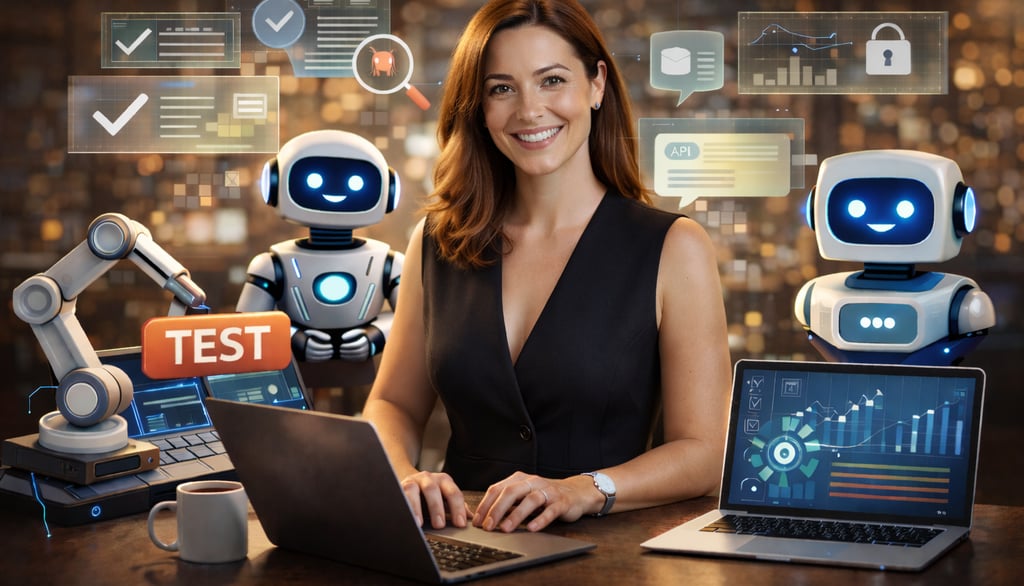
Artificial Intelligence is becoming a trusted companion in modern software testing. Rather than changing the purpose of Quality Assurance, AI is strengthening it. Today’s QA professionals are using AI tools to enhance analysis, accelerate execution, and improve decision making while retaining full ownership of quality outcomes.
Tools such as ChatGPT and Microsoft Copilot are increasingly embedded into the QA workflow. They do not act independently. They operate under the direction of skilled testers who understand business context, user behavior, and risk. This collaboration is redefining QA work and making it more impactful, strategic, and satisfying.
Static Testing Empowered by AI Assisted Review:
In static testing, QA professionals are responsible for validating requirements, user stories, and design documents before development begins. AI helps by quickly analyzing large volumes of documentation and highlighting potential gaps, ambiguities, and inconsistencies.
Human QAs actively use AI as a review accelerator. For example, a tester may ask AI to extract acceptance criteria from a user story or to identify non functional requirements hidden in descriptive text. This allows the QA to focus on validating intent, aligning requirements with business goals, and initiating meaningful conversations with product owners. AI speeds up discovery, while human testers ensure accuracy and relevance.
Test Planning Enhanced by Intelligent Drafting:
Test planning requires experience, foresight, and an understanding of both technical and business risk. AI assists by generating structured first drafts of test plans, risk lists, and coverage matrices based on project inputs.
QA leads use these drafts as a starting point. They refine priorities, adjust scope based on timelines and dependencies, and incorporate domain specific risks that AI cannot infer. Microsoft Copilot is often used to co author test plans directly in documentation tools, allowing QAs to spend less time formatting and more time strategizing. The final plan reflects human judgment, supported by AI efficiency.
Functional Testing Supported by AI Generated Coverage:
Functional testing demands thorough coverage and attention to detail. AI helps human testers generate comprehensive test cases from requirements, including positive paths, negative scenarios, and boundary conditions.
Human QA professionals review and curate these test cases. They remove redundancy, add real world usage patterns, and incorporate integration considerations that AI alone would miss. During execution, testers use AI to quickly validate expected outcomes, clarify business logic, and document defects clearly. AI expands coverage, while human testers ensure functional correctness and business alignment.
Automation Testing Accelerated by AI Assistance:
Automation testing benefits greatly from AI powered development support. QA engineers use AI to generate test scripts, understand framework behavior, and troubleshoot failures faster. ChatGPT helps explain complex automation logic, while Microsoft Copilot suggests code improvements directly within the IDE.
Human QAs remain in control of automation strategy. They decide which tests to automate, how to structure test suites, and how to maintain long term stability. AI reduces the cognitive load of writing and maintaining code, enabling testers to focus on designing reliable, maintainable automation that delivers consistent value.
UI and UX Feedback Strengthened by AI Insights:
UI and UX testing requires both analytical thinking and empathy. AI assists by reviewing interface text, layout consistency, accessibility rules, and basic usability heuristics.
Human testers use AI feedback as a checklist, not a verdict. They validate suggestions against real user expectations, cultural context, and brand voice. QAs also use AI to simulate feedback from different user personas, which helps broaden perspective during exploratory testing. The final UX recommendations come from human insight, informed by AI analysis.
Security Testing Guided by AI Awareness:
Security testing can be challenging for general QA teams. AI helps by increasing awareness and confidence. Testers use AI to understand common vulnerabilities, generate security test scenarios, and learn why certain risks matter.
Human QAs apply this knowledge thoughtfully. They evaluate which risks are realistic for the system under test, prioritize based on data sensitivity, and validate fixes through retesting. AI improves security literacy, while human testers ensure practical and context aware security validation.
Performance Testing Informed by AI Analysis:
Performance testing produces complex datasets that can be time consuming to interpret. AI helps by summarizing results, identifying trends, and flagging potential bottlenecks.
QA engineers use these insights to guide deeper analysis. They assess whether performance issues affect critical user journeys and whether they align with business expectations. Human testers collaborate with developers and infrastructure teams to translate AI insights into actionable recommendations. AI simplifies analysis, while human QA ensures relevance and accuracy.
API Testing Accelerated by AI Scenario Generation:
API testing often involves complex payloads, dependencies, and error handling scenarios. AI helps QA professionals generate request variations, boundary cases, and negative tests quickly.
Human testers refine these scenarios to reflect real integration flows and data dependencies. They validate responses within business context and ensure error handling aligns with downstream systems. AI reduces setup time, allowing testers to focus on deeper validation and integration quality.
Play Through Testing Enriched by AI Exploration
In play through testing, particularly for games and interactive systems, creativity and exploration are essential. AI helps by suggesting alternative play styles, edge case behaviors, and progression paths.
Human QA professionals use these suggestions to expand exploratory testing sessions. They evaluate balance, fairness, engagement, and exploit potential based on player psychology and experience. AI sparks ideas, while human testers assess enjoyment and realism.
Why AI Makes QA Work More Meaningful
AI has not changed the responsibility of Quality Assurance. It has enhanced the way that responsibility is fulfilled. By reducing repetitive effort and accelerating analysis, AI allows testers to spend more time on critical thinking, collaboration, and user advocacy.
Quality decisions still belong to humans. AI simply equips them with better tools, faster insights, and broader visibility. This is why QA professionals view AI not as a threat, but as a career multiplier.
The future of software testing is collaborative. When AI and human expertise work together, quality improves, teams move faster, and QA professionals deliver greater value than ever before.
Alternate Contact Details
Let's ensure quality products together.
Phone
+91 8007677300
© 2026. All rights reserved.
Address
167A-FF, URBAN ESTATE, SECTOR 45, GURGAON, HARYANA - 122003
GSTIN/UIN
06ACNFA5079N1ZR
Acumenworks technologies